
Currency glossary: terms simply explained
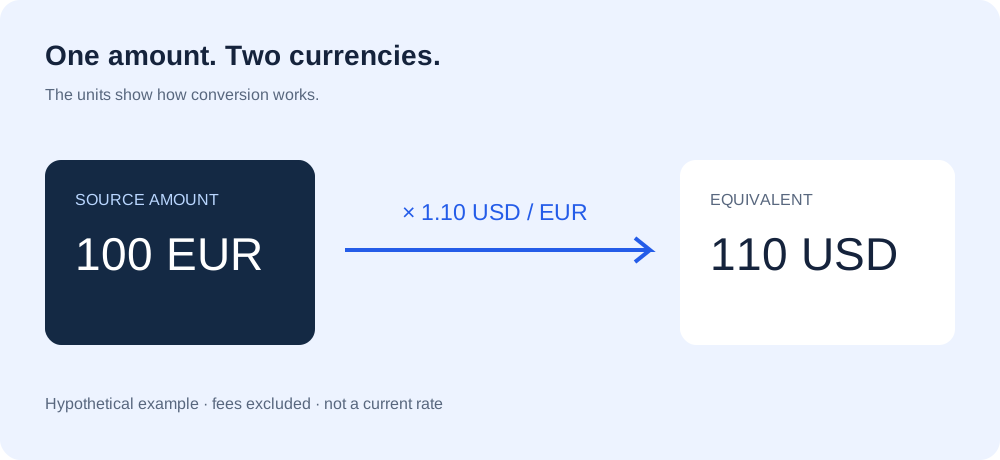
Base currency, cross rate, spread and reference rate: the essential terms for understanding currency conversion.
Base currency
- The first currency in a pair. In EUR/USD, one euro is the reference unit for the dollar amount shown.
Quote currency
- The second currency in a pair. It specifies the unit in which the price of one unit of the base currency is expressed.
Reference rate
- An exchange rate published for information and comparison. It is not a binding exchange offer from a bank.
Reciprocal
- One divided by the rate. This mathematically reverses a currency pair, provided the same data basis is used.
Cross rate
- A ratio calculated from two rates with a common base. With the euro as the common base, EUR/JPY divided by EUR/USD gives USD/JPY.
Spread
- The difference between buy and sell rates. A reference converter does not represent this difference as your personal exchange cost.
Rate markup
- A difference between an offered rate and a comparison basis. It can only be assessed with a clear rate direction, the same time and a suitable comparison rate.
Observation day
- The date to which a data value refers. It is not automatically the day you opened the website or your payment was booked.
Currency code
- An abbreviation for unambiguous selection, such as EUR for euro, USD for US dollar or CHF for Swiss franc. Currency symbols alone can be ambiguous.
Percentage rate change
- Last rate divided by first rate, minus one, multiplied by one hundred. It describes the change in the currency ratio between two observations, not a guaranteed return.