The date at a glance.
Conversions between different currencies show the dates of the observations used.

USD/AUD: convert amounts, compare trends and find the rate for your chosen date.

For guidance: reference rates are not binding buy or sell prices. Your bank's fees, markups and actual exchange terms are not included.
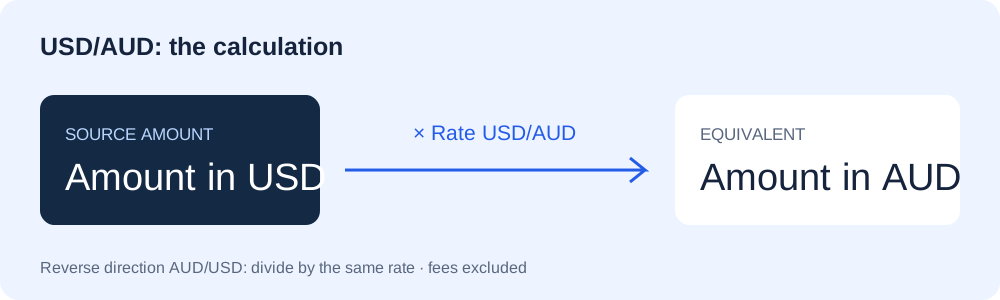
The table uses the same reference rates and direction as the converter above. Fees excluded.
| Source amount | Equivalent amount |
|---|---|
| Loading rates … | |
Choose a pair for the chart and historical conversion.
| Date | Target currency rate per 1 unit |
|---|
Daily reference rates. The line connects available observations; no rates are invented for days without publication. The vertical axis shows the range of values and does not necessarily start at zero. Past rate movements do not provide reliable predictions.
Equivalent of 1 USD
| Currency | Reference rate | Rate date | Converter |
|---|---|---|---|
| Loading rate data … | |||
For USD/AUD, USD (US dollar) is the source currency and AUD (Australian dollar) is the target currency. The rate shows how many units of AUD equal one unit of USD. Multiply your USD amount by this rate to obtain the calculated AUD amount. Individual exchange fees are not included.
For AUD/USD, use the arrow to swap the direction. Alternatively, divide an amount in AUD by the USD/AUD rate. Use unrounded values: the displayed inverse rate may be limited to six decimal places. Buy and sell prices in an actual exchange offer may differ.
The rate is calculated from two euro reference values: EUR/AUD divided by EUR/USD gives USD/AUD. Historical values are combined only when both observations are from the same day. The observation date appears beside the result. Opening the page does not turn an older rate into a new one.
The chart compares available daily values over one month, one year or five years. The first and last observations determine the displayed change. High and low refer to reference values, not every executable price during a day. Missing publication days are not filled with artificial values.
Choose an amount and date in the historical converter. For days without a shared observation, it searches backwards by no more than 14 days. Your requested date and the rate date actually used are shown separately. If there is no suitable USD/AUD observation, a message appears. Selectable periods do not promise uninterrupted data.
A reference amount in AUD is not a binding offer. A payment service may use a different time, its own rate or additional fees. Compare the total USD charge with the AUD amount actually paid out. The converter does not execute payments.
Formulas and worked examples · Compare fees · Calculation and guidance
Conversions between different currencies show the dates of the observations used.
Amount times exchange rate gives the equivalent value. For two other currencies, the ratio of their euro rates is calculated.
New reference rates appear on publication days. At weekends and on other days without publication, the latest available rate remains the reference.
Why does the bank's rate differ? What does the reciprocal mean? How are two currencies compared? Our explanations help you interpret the numbers.