
Historical exchange rates: requested dates and rate dates explained
Convert historical amounts and interpret rate dates: observation days, weekends and the limits of the data series.
Distinguish the requested date from the observation day
A historical conversion shows the calculated equivalent of an amount at a past exchange rate. It requires a currency pair, an amount and a date. However, the selected calendar day is not always a publication day. Our historical converter therefore shows both your requested date and the date of the rate actually used.
What happens at weekends and on holidays
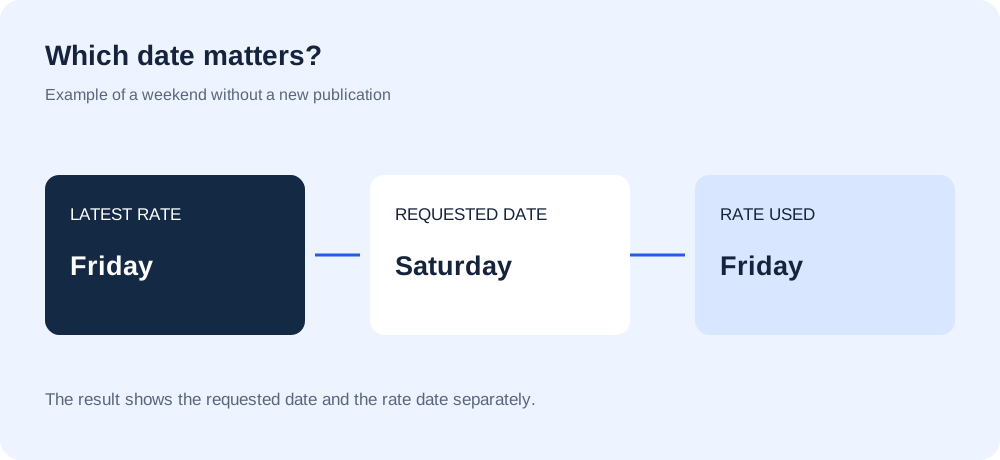
If there is no shared observation on your requested date, the converter searches backwards. It uses the latest available shared rate on or before that day, going back no more than 14 days. For a Saturday, this might be Friday. If there are no matching data within this window, a message appears instead of an invented or much older value.
Why data coverage varies
Not every currency has a value for every past day in the data series. The converter accepts dates from 4 January 1999, but this does not promise uninterrupted coverage for all selectable currencies. Missing publications, different start dates and changes to currencies may limit coverage. Always check the rate date shown with a historical result.
A rate on one date is not an average
A single day's rate differs from a monthly or annual average. Nor do the first and last rates of a period together represent its average. Our historical converter uses one observation, while the chart shows the available daily values over a period. For USD/JPY, the dollar and yen rates against the euro are combined using observations from the same day.
When you need a different data basis
An actual past bank debit may differ from the historical reference amount because of fees, a different booking date or different rate rules. For accounting or other purposes with specified requirements, establish which source and date are required. Our result documents an indicative conversion and does not replace evidence of an executed transaction.
Understand the calculation
The numerical examples are hypothetical. How the converter works explains the calculation and its limits.